
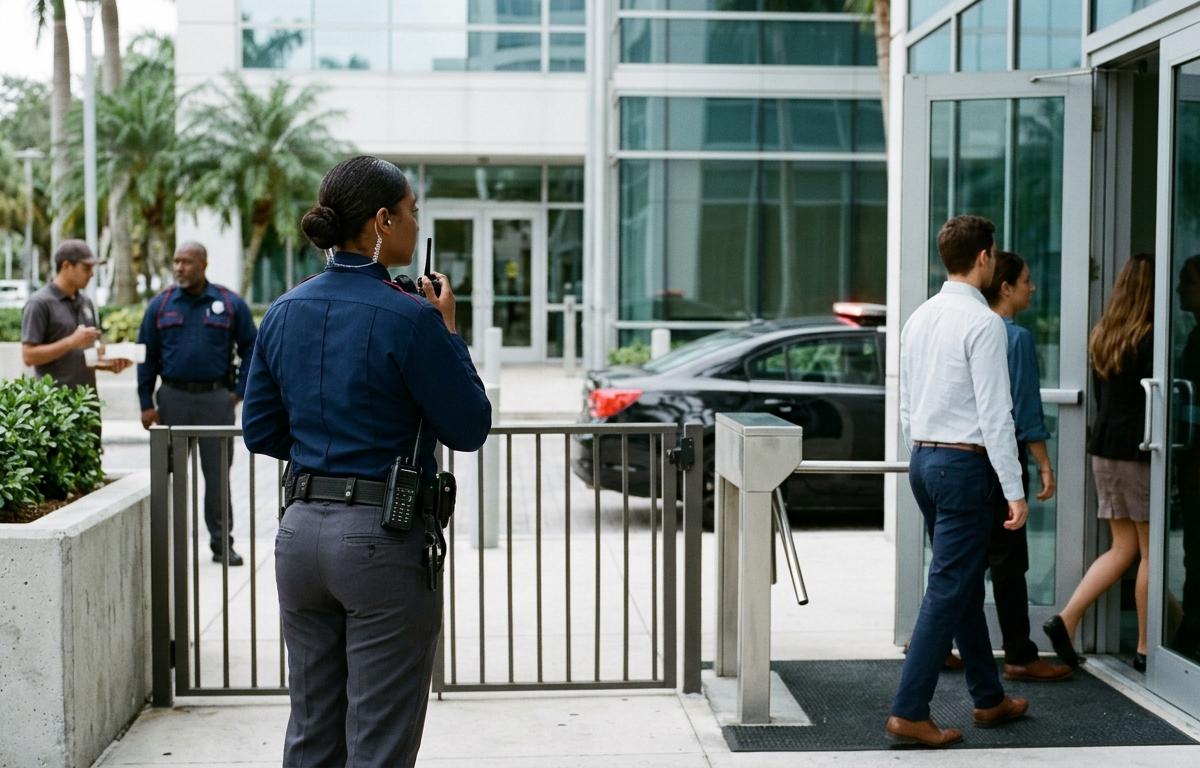
The best security guard companies in South Florida 2026 share three traits you can check yourself: a state-issued Class "B" agency license, a current certificate of liability insurance, and officers licensed through the Florida Department of Agriculture and Consumer Services (FDACS). One option worth shortlisting is nationalalertsecurity.com, a veteran-owned, fully licensed agency serving primarily Miami-Dade, Broward and Palm Beach counties with armed and unarmed officers, executive protection, and commercial, residential and transportation security. Expect guard wages in the metro to run roughly $18 to $20 an hour, with client bill rates higher once agency overhead is added.
No verified ratings or comparisons exist for named South Florida firms, so this article can’t rank the best security guard companies in South Florida 2026 head to head. What it can do is show you how to separate good agencies from bad ones, so your shortlist holds up.
South Florida buyers generally choose among four kinds of providers, and matching the type to your need matters more than any brand name.
Full-service local agencies supply uniformed armed and unarmed officers, patrols and post coverage, often with 24/7 dispatch. They suit condos, apartment communities, medical offices, warehouses and retail centers that need ongoing, scheduled coverage. A regional firm such as National Alert Security, with commercial security services and residential security services under one roof, fits this model, and its staff are mostly former military and law enforcement.
Executive protection and bodyguard firms focus on people rather than property. They fit executives, dignitaries, high-profile families and anyone facing a specific threat. Armed work here usually requires officers holding the Class "G" firearm license. Our guide to executive protection and bodyguard services explains how those engagements are structured.
Event and construction-site specialists staff temporary or high-turnover locations: concerts, private events, job sites with equipment theft risk. The research behind this guide didn’t verify pricing for these services, so ask for written quotes rather than leaning on published averages.
Staffing agencies place guards into your own operation. That’s a different model from an outsourced security company, with different supervision and liability arrangements, so ask who actually manages the officers on shift.
Whichever type you pick, the same licensing checks apply, covered next.
Anyone working as a security officer in Florida needs a license from the FDACS Division of Licensing, under Chapter 493 of the Florida Statutes, as the FDACS private security license page explains. Before you sign, confirm each of the following.
The agency holds a Class "B" license. Any firm doing business as a security agency must have one. A Class "B" license is valid for only one location, and each branch office needs its own Class "BB" license. If a company dispatches guards across Miami-Dade, Broward and Palm Beach from several offices, ask which license covers which location.
A licensed manager runs the agency. The manager of a Class "B" agency needs a Class "MB" license, which requires two years of verifiable experience or training in security work or related fields.
Insurance is on file and current. Under Chapter 493, a Class "B" license can’t be issued unless the applicant first files a certification of insurance showing commercial general liability coverage. Don’t stop at the state’s filing. Ask the agency for a current certificate naming your property as certificate holder, along with the policy’s limits and expiration date.
Individual officers are licensed. Unarmed officers hold a Class "D" license, which requires 40 hours of training at a licensed school, fingerprinting and a background check. Armed officers also need a Class "G" license, an additional firearm license that doesn’t replace the Class "D." Class "G" training is 28 hours with a Class "K" instructor, plus a 4-hour requalification every year for each firearm type carried.
Licenses are not expired. Agency licenses run 3 years; officer licenses generally run 2 years. Ask for license numbers, then check them against the FDACS database yourself instead of trusting a PDF.
A reputable firm hands all of this over without hesitation. If you sense reluctance, treat it as your answer.
Published figures describe what guards earn, not what you pay. Your bill rate covers wages plus payroll taxes, insurance, supervision, uniforms, equipment and agency margin, so it will always exceed the figures below. Treat every number here as an estimate from aggregators and vendors, not a quote.
On the wage side, a training-school blog citing federal data puts the median security guard wage in the Miami–Fort Lauderdale–West Palm Beach metro at $17.33 per hour, about $36,040 a year. ZipRecruiter reports an average of $16.34 per hour for unarmed guards in Miami and $19.55 per hour for armed guards.
On the billing side, one Miami vendor states that unarmed Class D officers bill from roughly $28 an hour and armed Class G officers from roughly $34. That’s vendor marketing, so use it only as a rough sanity check. If a quote lands far below the wage figures above, the agency is probably underpaying staff, skipping insurance or using unlicensed guards. If it lands far above, ask what’s bundled in.
Verified rate data for Broward and Palm Beach, and for executive protection, event staffing and construction sites, wasn’t available for this guide. For bodyguard-level work, see how much a bodyguard costs. Get at least three written quotes, with the same post hours and requirements, so you compare like with like.
Unarmed officers are best for visibility, access control, front-desk presence, patrol and incident reporting. They’re the standard choice for office buildings, retail, apartment communities and most daytime commercial posts, at the lower end of the pay range. Their standout trait is deterrence at a lower cost.
Armed officers are best where the risk includes violence or high-value assets: cash handling, jewelry, pharmacies, certain healthcare and executive settings. Wages average roughly $3 an hour higher than unarmed, per the ZipRecruiter figures above, and the licensing burden is heavier. A Class "G" license isn’t a concealed weapon license, so the firearm is carried openly, and approved handguns are limited to specific calibers. Armed coverage also raises your liability and insurance questions, so confirm the agency’s policy explicitly covers armed posts.
Specialty services sit between these. Executive protection and bodyguard teams are best for people at risk, with armed officers common. Transportation security is best for moving executives or valuables, and bodyguards and security drivers generally need the Class "G" to work armed. Residential and gated-community security is best for condos and estates wanting patrol and gate control. Commercial post security suits businesses and healthcare facilities needing steady scheduled coverage. For related offerings, review security officers, personal security and transportation security services.
Work through these criteria in order and a shortlist emerges quickly.
If you’d like a conversation with a licensed local option, you can contact National Alert Security to discuss your property, hours and risk level.
Among the best security guard companies in South Florida 2026, worth hiring means licensed, insured and local. Look for a Class "B" agency license, a current liability insurance certificate, and Class "D" or "G" licensed officers, then compare written quotes from at least three agencies. National Alert Security is one veteran-owned, licensed option serving Miami-Dade, Broward and Palm Beach.
Guard wages average about $16.34 an hour unarmed and $19.55 armed on ZipRecruiter, but client bill rates are higher. One Miami vendor cites roughly $28 an hour unarmed and $34 armed. Treat these as estimates and get written quotes.
Armed officers earn roughly $3 more per hour in wages on the ZipRecruiter figures, and the vendor billing figures show a similar gap of about $6 an hour. Armed coverage also adds Class "G" licensing, requalification and insurance considerations.
Yes. Anyone working as a security officer needs an FDACS license under Chapter 493, and the agency employing them needs a Class "B" license. Confirm both before signing a contract.